It’s Maths!!

Posted in General with tags , , on January 20, 2010 by Admin

Maths Forum

Not only talks about Conic section(Circle) but also

other math topics.

KLIK to view;)

………………………………………………………………………………………………………

Here’s another link which I think helps a lot for those who had troubles with Conic Section

Click HERE or HERE

or maybe HERE.

The Tab Tutor program sure is useful;)


moderator,

Nor Hidayah Binti Kamin

Inscribed Angles

Posted in The Angle of Circle with tags , on January 20, 2010 by dramakcjt

by,

Kong Ngiik Hiong

angle of circle

Posted in The Angle of Circle with tags on January 20, 2010 by dramakcjt

Inscribed Angles Conjectures


Explanation:

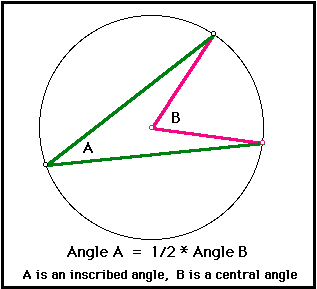
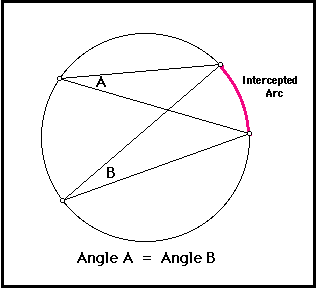
An inscribed angle is an angle formed by two chords in a circle which have a common endpoint. This common endpoint forms the vertex of the inscribed angle. The other two endpoints define what we call an intercepted arc on the circle. The intercepted arc might be thought of as the part of the circle which is “inside” the inscribed angle. (See the pink part of the circle in the picture above.)

A central angle is any angle whose vertex is located at the center of a circle. A central angle necessarily passes through two points on the circle, which in turn divide the circle into two arcs: a major arc and a minor arc. The minor arc is the smaller of the two arcs, while the major arc is the bigger. We define the arc angle to be the measure of the central angle which intercepts it.

The Inscribed Angle Conjecture I gives the relationship between the measures of an inscribed angle and the intercepted arc angle. It says that the measure of the intercepted arc is twice that of the inscribed angle.

The precise statements of the conjectures are given below. Each conjecture has a linked Sketch Pad demonstration to illustrate its truth (proof by Geometer’s Sketch Pad!). The linked activities sheet also include directions for further “hands on” investigations involving these conjectures, as well as geometric problems which utilize their results.


The precise statement of the conjectures:

Conjecture (Inscribed Angles Conjecture I ): In a circle, the measure of an inscribed angle is half the measure of the central angle with the same intercepted arc..


Corollary (Inscribed Angles Conjecture II ): In a circle, two inscribed angles with the same intercepted arc are congruent.

Proof: The measure of each inscribed angle is exactly half the measure of its intercepted arc. Since they have the same intercepted arc, they have the same measure.


Corollary (Inscribed Angles Conjecture III ): Any angle inscribed in a semi-circle is a right angle.

Proof: The intercepted arc for an angle inscribed in a semi-circle is 180 degrees. Therefore the measure of the angle must be half of 180, or 90 degrees. In other words, the angle is a right angle.

by,

Kong Ngiik Hiong

Picture of circle applications

Posted in Gallery with tags , , , on January 20, 2010 by ctsuraidah

Post by,

ctsuraidah

Hello Again…

Posted in General on January 16, 2010 by Admin

It’s been such a long time since this blog is created.And whadaa…everyone is participating I can say.

Thanx a lot for the coorperation my dear tutorialmate.And if you are facing any problem related to posting and such,just give me a call or text me;)

Here are the list of those who already post:

1.NOR HIDAYAH BINTI KAMIN

2.ELENA ROZELLA JARID

3.SITTI SURAIDAH BINTI ANAS

4.BONG SING KOCK

5.KONG NGIIK HIONG

6.WONG SWAN SWAN

7.DELTA JENNETY DENIL

8.MARK RYAN

9.SEAH SHU YEN

10.HEPERIZAN JUNAIDI

11.GLORIA TERRENCE FIRAON

12.SAWAI A/K JANTAN

13.ERICA OLIVIA HENRY

14.GLORIA HAREN SAGING

15.DAPHNE GEORGE

16.MELSON MANGGIS

17.CAROLYNE DAIRIS

thanx again for those who has posted.and double thanx to those who posted 2 post(what a hardworking person you areO_0)

I hope the rest will post soon.

Thank you.

Moderator,

NOR HIDAYAH KAMIN

Pictures of Application of Circle

Posted in Application of Circle on January 12, 2010 by Admin


by,

Carolyne Dairis

Uploaded by,

Admin


Equation of circle

Posted in Equation Of Circle on January 10, 2010 by daphne27

EQUATION OF A CIRCLE      

 
The equation of a circle comes in two forms: 
  1) The standard form:  (x – h)2  +  (y-k)2   =   r2
  2) The general form  :  x2  +  y2  +  Dx  +  Ey  +  F   =   0,   where D, E, F are constants.
       
If the equation of a circle is in the standard form, we can easily identify the center of the circle, (h, k), and the radius, r .  Note: The radius, r, is always positive.
     
Example 1:   (x-2)2 + (y-3)2 = 4.    (a)  Find the center and radius of the circle.  (b) Graph the circle. 
     
Note:    A common mistake is to take h= -2 and K= -3.   In an equation, if the sign preceding h and k , ( h, k)  are  negative, then h and k are positive.  That is, h= 2 and k= 3.
    
(a)  Center: (h= 2, k= 3) = ( 2, 3 )    and     radius   r=2   since    r2 =  4   =>   r = Ö4 = 2
(b)  The graph is                                            
   
Example 2:    (x+1)2 + (y-2)2 = 9.     (a)  Find the center and radius of the circle.  (b) Graph the circle.
   
Note:  To correctly identify the center of the circle we have to place the equation in the standard form:
The standard form is:   (x –    h)2   +  (y-k)2 =   r2
  (x – (-1))2  +  (y-2)2 = (3)2.  Now, you can identify the center correctly.
  
(a)  Center: (h= -1, k= 2) = ( -1, 2 )         and radius          r=3   since    r2= 9   >     r=Ö9=3
(b)  The graph is                                                                 
   
Example 3:        2x2  +  2y2  =  8.     (a) Find the center and radius of the circle.  (b) Graph the circle.
  
Note:  To correctly identify the center of the circle we have to place the equation in the standard form.
First divide the equation by 2.  The new equation is :     x2     +     y2      =   4   .
The standard form: (x – h)2 + (y – k)2  =   r2
  (x – 0)2 + (y – 0)2  = (2)2.  Now, you can identify the center correctly.
  
(a)  Center:    (h= 0, k= 0) = ( 0, 0 )         and   radius   r = 2   since   r2 =  4   =>     r = Ö4 = 2
(b)  The graph is                                                
  
If the equation is in the general form, we have to complete the square and bring the equation in the standard form.  Then, we can identify the center and radius correctly.  We learned how to complete the square when working with quadratic equations (E III).  We will review it through an example.
  
Example 4:   x2  +  y2  – 6x  +  4y  +  9  =  0.    (a)  Find the center and radius of the circle.  (b) Graph the circle.
  
Completing the square:
  • Write the equation in this form:   (x2 – 6x +   ?1  ) + (y2 + 4y +    ?2  ) = -9   + ?1  +  ?2 . In the first parenthesis, we group the x-terms and in the second the y-terms.  The constant is moved on the right hand side. The question mark, ?, is the number needed in each parenthesis to complete the square.   Note that we have to add this number to both sides of the equation.  That is why you see ?1  and ?2, added to both sides.
  • How to find the number to replace the question mark, ?1.   Take the coefficient of x and divide it by 2,  (-6/2), and then square it,  (-3)2 = 9.     ?1   is going to be replaced by the number 9.
  • How to find the number to replace the question mark, ?2.   Take the coefficient of y and divide it by 2,  (4/2), and then square it,  (2)2 = 4.     ?2    is going to be replaced by the number 4.
 
Putting steps 1-3 together we have the following:
  (x2 – 6x +   ?1  )  +  (y2 + 4y +    ?2  )  =  -9   +  ?1  +  ?2
  (x2 – 6x +    9  )   +  (y2 + 4y +     4   )  = -9   +   9   +  4
         ( x – 3 )2       +       ( y  +  2 )2        =  4
         ( x – 3 )2       +       ( y  – (-2) )2      =  4    This equation is in the standard form.
 
(a)  Center:      (h= 3, k= -2) = ( 3, -2 )     and    radius     r = 2     since    r2 =  4   =>     r =  Ö4  =  2
(b)  The graph is                                             
  
Example 5:    x2  +  y2  – 6x  +  2y  +  4  =  0.    (a)  Find the center and radius of the circle.  (b) Graph the circle.
  
Completing the square:
  • Write the equation in this form:   (x2 – 6x +   ?1  ) + (y2 + 2y +    ?2  ) = -4   + ?1  +  ?2 . In the first parenthesis, we group the x-terms and in the second the y-terms.  The constant is moved on the right hand side. The question mark, ?, is the number needed in each parenthesis to complete the square.   Note that we have to add this number to both sides of the equation.  That is why you see ?1  and ?2, added to both sides.
  • How to find the number to replace the question mark, ?1.   Take the coefficient of x and divide it by 2,  (-6/2), and then square it,  (-3)2 = 9.     ?1    is going to be replaced by the number 9.
  • How to find the number to replace the question mark, ?2.   Take the coefficient of y and divide it by 2,  (2/2), and then square it,  (1)2 = 1.       ?2   is going to be replaced by the number 1.
 
Putting steps 1-3 together we have the following:
  (x2 – 6x +   ?1  )  +  (y2 + 2y +    ?2  )  =  -4   +  ?1  +  ?2
  (x2 – 6x +    9  )   +  (y2 + 2y +     1   )  = -4   +   9   +   1
         ( x – 3 )2       +       ( y  +  1 )2        =  4
         ( x – 3 )2       +       ( y  – (-1) )2      =  4    This equation is in the standard form.
 
(a)  Center:      (h= 3, k= -1) = ( 3, -1 )     and    radius     r = 2     since    r2 =  4   =>     r =  Ö4  =  2
(b)  The graph is                                              


by,

Daphne George

Circle Theorems

Posted in The Angle of Circle with tags , , , , , , , , , , , , on January 10, 2010 by merrusmsk

Circle Theorems

Circles

A circle is a set of points which are all a certain distance from a fixed point known as the centre.
A line joining the centre of a circle to any of the points on the circle is known as a radius.

The circumference of a circle is the length of the circle. The circumference of a circle = 2 × π × the radius.

a sector, an arc and chord

The red line in the second diagram is called a chord. It divides the circle into a major segment and a minor segment.

Theorems

Angles Subtended on the Same Arc

Angles subtended on the same arc

Angles formed from two points on the circumference are equal to other angles, in the same arc, formed from those two points.

Angle in a Semi-Circle

angle in a semi-circle

Angles formed by drawing lines from the ends of the diameter of a circle to its circumference form a right angle. So c is a right angle.

This proof is higher tier Proof

We can split the triangle in two by drawing a line from the centre of the circle to the point on the circumference our triangle touches.

Divide the triangle in two

We know that each of the lines which is a radius of the circle (the green lines) are the same length. Therefore each of the two triangles is isosceles and has a pair of equal angles.

Two isosceles triangles

But all of these angles together must add up to 180°, since they are the angles of the original big triangle.

Therefore x + y + x + y = 180, in other words 2(x + y) = 180.
and so x + y = 90. But x + y is the size of the angle we wanted to find.

Tangents

A tangent to a circle is a straight line which touches the circle at only one point (so it does not cross the circle- it just touches it).

A tangent to a circle forms a right angle with the circle’s radius, at the point of contact of the tangent.

angle with a tangent

Also, if two tangents are drawn on a circle and they cross, the lengths of the two tangents (from the point where they touch the circle to the point where they cross) will be the same.

Tangents from an external point are equal in length

Angle at the Centre

Angle at the centre

The angle formed at the centre of the circle by lines originating from two points on the circle’s circumference is double the angle formed on the circumference of the circle by lines originating from the same points. i.e. a = 2b.

This proof is higher tier Proof

You might have to be able to prove this fact:

proof diagram 1

OA = OX since both of these are equal to the radius of the circle. The triangle AOX is therefore isosceles and so ∠OXA = a
Similarly, ∠OXB = b

proof diagram 2
Since the angles in a triangle add up to 180, we know that ∠XOA = 180 – 2a
Similarly, ∠BOX = 180 – 2b
Since the angles around a point add up to 360, we have that ∠AOB = 360 – ∠XOA – ∠BOX
= 360 – (180 – 2a) – (180 – 2b)
= 2a + 2b = 2(a + b) = 2 ∠AXB

This section is higher tier Alternate Segment Theorem

Alternate segment theorem

This diagram shows the alternate segment theorem. In short, the red angles are equal to each other and the green angles are equal to each other.

Proof

You may have to be able to prove the alternate segment theorem:

proof of alternate segment theorem

We use facts about related angles:

A tangent makes an angle of 90 degrees with the radius of a circle, so we know that ∠OAC + x = 90.
The angle in a semi-circle is 90, so ∠BCA = 90.
The angles in a triangle add up to 180, so ∠BCA + ∠OAC + y = 180
Therefore 90 + ∠OAC + y = 180 and so ∠OAC + y = 90
But OAC + x = 90, so ∠OAC + x = ∠OAC + y
Hence x = y

Cyclic Quadrilaterals

A cyclic quadrilateral is a four-sided figure in a circle, with each vertex (corner) of the quadrilateral touching the circumference of the circle. The opposite angles of such a quadrilateral add up to 180 degrees.

This proof is higher tier Area of Sector and Arc Length

A sector

If the radius of the circle is r,
Area of sector = πr2 × A/360
Arc length = 2πr × A/360

In other words, area of sector = area of circle × A/360
arc length = circumference of circle × A/360

Fof more detail just type circle theorem in ur search list..

by

Melson Manggis

Equation of circle

Posted in Equation Of Circle on January 10, 2010 by daphne27

STANDARD EQUATION OF A CIRCLE 


The equation of a circle with the centre at (a, b) and radius r, is given by (x – a)2 + (y – b)2 = r2 .If the centre of the circle is at the origin and the radius is r, then equation of circle is x2 + y2 = r2.

circle

EQUATION OF CIRCLE IN DIFFERENT CONDITIONS 


Condition        Equation  
 (i)         Touches both the  axes with  centre (a, a) and  radius a  (x-a)2  + (y-a)2  = a2 circle
 (ii)        Touches  x-axis only with centre             (a, a)  and  radius  a  (x-α)2 + (y-a)2  = a2 circle
 (iii)       Touches y-axis only with centre (a, b)              and radius  a  (x-a)2 + (y-β)2 = a2 circle
 (iv)      Passes through the origin with centre             (α/2, b/2) and radius √(α2 + b2/4) x2 +a y2 – αx – by  = 0 circle


by,

Daphne George

Equation Of Circle

Posted in Equation Of Circle with tags on January 10, 2010 by msrica

This article is taken from the notes for my Math 107 web page. It’s purpose is to explain how to find equations for circles and also how to use this knowledge to provide a shortcut for graphing such equations. In order to do this you need to know two things.

  1. The distance formula
  2. The definition of a circle

For the distance formula see my notes.

What is a circle?

ãA circle is a set of all points equidistant from a point.

That is the standard geometry definition for a circle, and it is this kind of definition that allows us to write down equations for things like circles. Since we have a definition in terms of distances, we can use the distance formula to come up with an equation. Remember that the equation for a geometrical figure is an equation that all of the points in it have to satisfy, a kind of entrance test to get on the graph.

The point we want to make our points equidistant from is called the center and the distance is called the radius. (Think about how you draw a circle with a compass.) So let’s find the equation of the circle with radius r and center (h,k). I am using (h,k) for the coordinates of the circle rather than (x,y) because I have to reserve (x,y) for the points on the circle.

By the distance formula, the distance between (x,y) and (h,k) is given by this expression. By our definition of a circle, in order for (x,y) to pass the entrance test, this must be r, so we get this. This looks nicer if we square both sides, so we get this. for the standard equation of a circle with center (h,k) and radius r.

This means that if you were asked to write down the equation for a circle with a given center and radius you should be able to do this by just putting the numbers into this formula. You would substitute the x coordinate of the center for h and the y coordinate of the center for k and the radius for r.

Example: Find the equation of the circle with center (2,3) and radius 5.

Solution: Just put the 2 where the h is and the 3 where the k is and the 5 where the r is to get the equation.

(x-2)2+(y-3)2=25

This means that if someone were to plot all of the points that satisfy this equation, they would get exactly the circle that we want them to get, namely the one that has a center at (2,3) and a radius of 5.

Knowing about this standard equation for a circle can also be useful for making it easier to graph equations, because now whenever you see an equation like this, you don’t need to plot any points, you just need to recognize it is of this form and draw the circle. Before when you graphed equations you could only do it be just substituting x’s and y’s and finding points.  If you have an equation of this kind of form and are asked to graph it, you need to find the center and the radius of the circle, so you need to recognize what the h, k, and r are. The right side of the equation will be r2, so to find r, you have to take its square root. You need to put the left side into the form (x-h)2+(y-k)2 in order to determine h and k. One problem you might have is that you might have addition instead of subtraction, so to deal with this you would have to see addition as subtracting a negative, which is kind of backwards of the way we normally think about these things. My suggestion for an approach so that you don’t have to remember too many things like that is just always find x and y so that what is in the parentheses is 0, and that will be your h and k, the coordinates of the center. Then once you have found the center and the radius of the circle, you can graph it by plotting the center and then drawing a circle of radius r around that center. A good way to do this is to plot four points, r to the right, r to the left, r up, and r down from the center and then just sketch a circle through those points. It doesn’t have to be perfect, just try your best. The main thing is that you show you teacher that you know what the center and radius is and what that means.

But since math instructors are all are mean and wicked, there is one more problem I need to tell how to deal with. The problem is, somebody just might have taken a nice equation for a circle like

(x+1)2+(y-2)2=9,

and expanded everything out and rearranged things like this

x2+2x+1+y2-4y+4=9
x2+y2+2x-4y-5=0,

and then presented you with the equation

x2+y2+2x-4y-5=0

to graph. The problem is that it is a lot easier to expand that out than to put it back to where it came from. But there is a way to do it and it is to use the method of completing the squares. So here is what you do.

Get all the x’s together and all the y’s together and add something to both sides to get the constant on the right side of the equation. Leave space so that there is room to complete the square.

x2+2x         +y2-4y        =5

Then complete the square to find something to add to the x’s part and something to add to the y’s part so that they are both perfect squares. Remember to complete the square you take half of the coefficient and the square it, so for the x’s you get 2/2=1, 12=1, so you add 1, and for the y’s 4/2=2, 22=4, so you add 4. (You don’t have to worry about the minus on the 4 because you are going to square, so it will go away anyway.)

x2+2x +1+y2-4y +4=5+1+4

Then write the left side as squares and add up the right side and you get

(x+1)2+(y-2)2=9,

and now you can find the center and radius and graph it. Here the center would be (-1,2) and the radius would be 3. So to graph it, all you need to do is find the point (-1,2) and then plot the points 3 up, 3 down, 3 to the right, and 3 to the left of it, and draw the circle through them.

by,

Erica Olivia Henry

Create your own website, free on WordPress.com.Create your own website.
Start free